Insights
Better agency workflow management starts with client context
Agency workflows break when client information gets separated from the work. Here’s how Synapic connects briefs, campaign history, planning and reporting so teams can spend less time rebuilding context.
Ivar Krustok
· 7 min read
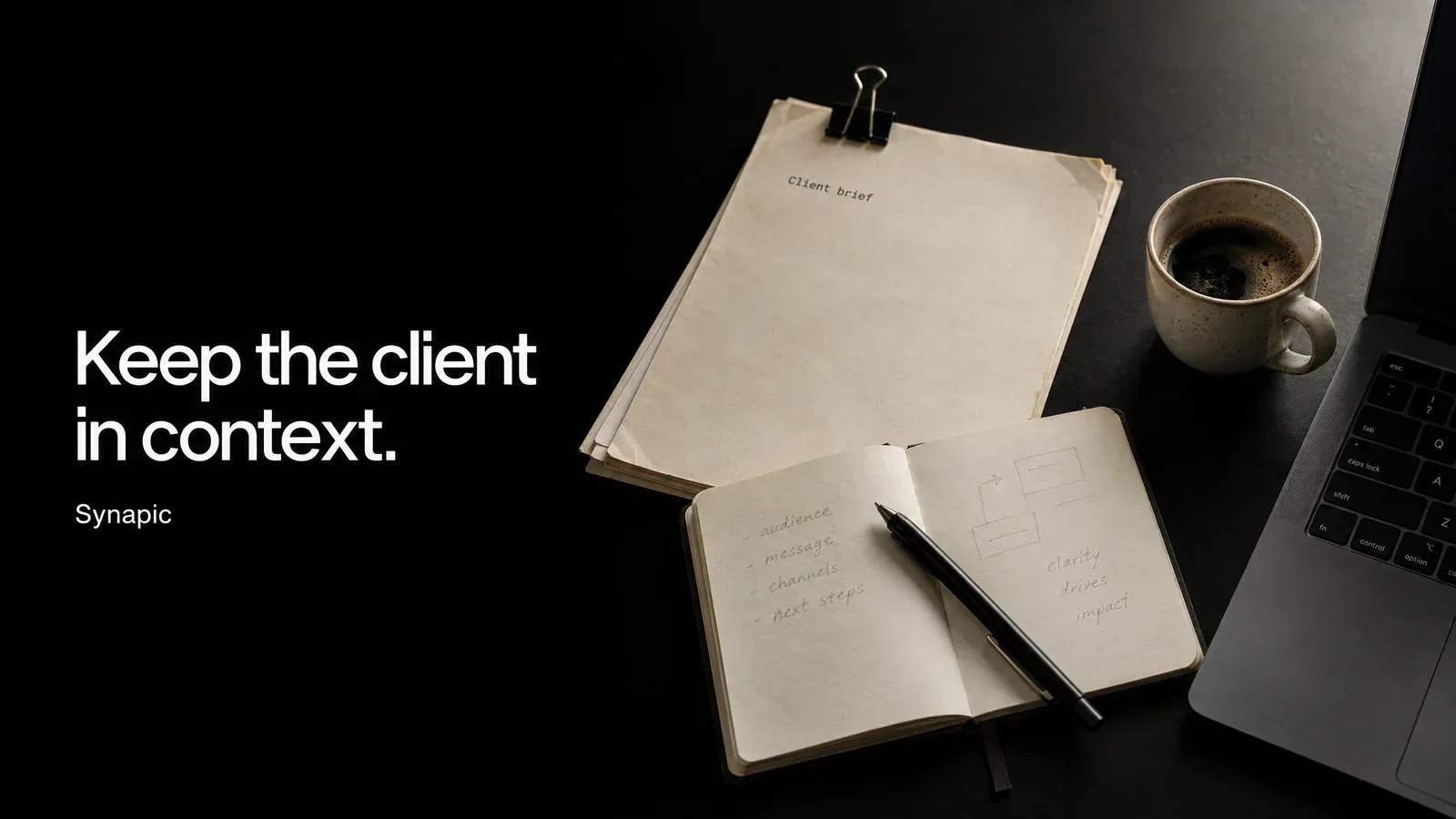
The client changes the brief. Strategy has the update. The media planner is still working from last week’s version, and the reporting team is measuring success against the original objectives.
Nobody has dropped the ball. The information just hasn’t travelled with the work.
This is what agency workflow fragmentation often looks like. Not a dramatic breakdown, but a series of small gaps between capable people using perfectly good tools. Someone checks an old email. Someone rebuilds a summary. Someone discovers an important constraint after the plan is almost finished.
Better agency workflow management needs to address those gaps, not simply make individual tasks faster. That starts with keeping client context connected from the first brief to the final report.
Synapic is built around that idea: a shared workspace where client intelligence informs strategy, media planning and reporting, with AI agents assisting the team and specialists retaining the final call.
Why agency workflows become fragmented
An agency’s tools usually arrive one problem at a time. A planning spreadsheet works well for budgets. A dashboard helps with campaign performance. Presentation software handles the pitch. A shared drive stores the brief.
Each serves a purpose. The difficulty is keeping the meaning behind the work intact as it moves between them.
A campaign brief might explain who the audience is, but not why the client ruled out a particular channel. A report might show an increase in conversions without mentioning that the offer changed halfway through the campaign. The account lead may remember both details. The person preparing the next strategy may not.
The cost shows up in repeated questions, avoidable revisions and decisions made with only part of the picture. Handoffs become informal briefings, and experienced colleagues spend time acting as the agency’s memory.
A task board can tell you that a media plan is due on Thursday. It doesn’t necessarily tell you what the planner needs to know to make it a good one.
What connected client context actually means
Connected client context brings the information that explains a client’s work into a shared, usable knowledge layer.
It includes the current brief, but also campaign history, performance data, survey findings and stakeholder context. Together, those inputs help a team understand what the client is trying to achieve, what has already been tried and which considerations matter for the next decision.
Synapic calls this its client brain. Its client intelligence tool, Aju, centralises client knowledge and lets team members ask questions in natural language, with sourced answers. AI agents can draw on that context when developing recommendations.
That makes the information useful beyond the person who collected it. A planner can consult campaign history. A strategist can bring audience feedback into the next brief. A colleague joining the account has a place to start without relying entirely on someone else’s recollection.
There is still work involved in maintaining useful context. Teams need to capture important decisions and keep their inputs current. A connected workspace makes that knowledge available; it cannot recover an agreement nobody recorded.
How Synapic connects the agency workflow
The benefit becomes clearer when you follow a campaign through the agency rather than look at each tool in isolation.
Strategy starts with the client’s history
Consider a retailer planning its next seasonal campaign. Before choosing a channel mix, the team needs to understand the previous campaign, the new objectives and what audience feedback suggests.
In a fragmented workflow, that preparation means collecting reports, finding the right brief and asking the account lead what changed. With shared client intelligence, those inputs can inform the strategy in the same workspace.
Synapic’s Kompass tool uses client briefs, historical performance and market context to generate media strategy recommendations. It provides channel-mix and budget guidance with supporting rationale, giving strategists a draft to assess rather than asking them to start from an empty document.
The strategist still needs to judge whether the recommendation fits the client. The useful change is that the starting point carries relevant context.
Media planning stays close to the strategy
A strategy can lose detail when it becomes a separate planning exercise. The channel recommendation survives, but the assumptions behind it may not.
Platvorm, Synapic’s media planning tool, brings TV, radio, out-of-home, digital and social planning into one grid. Budgets, reach estimates and timelines sit together, making it easier to consider the plan across channels rather than assemble it from separate sheets.
Within a shared client workspace, teams can keep the brief and campaign history in reach while developing the plan. That matters when a budget changes or a campaign flight needs adjusting: the decision should reflect the client’s objectives, not just the easiest cell to edit.
Reporting helps inform the next brief
Reporting is often treated as the last job in a campaign. It should also be preparation for the next one.
Synapic’s Vool tool combines cross-channel performance data with charts, AI-written commentary and recommendations. The aim is to turn separate channel results into a report people can read and discuss, rather than another collection of exports.
Those performance signals also belong in the client’s wider knowledge base. Keeping them alongside campaign history helps the next planning discussion begin with what the team has learned.
A report doesn’t prove why every result happened. Analysts still need to examine the data and challenge the interpretation. Connected context gives them more of the relevant background to work with.
You can explore Synapic’s client intelligence, planning and reporting tools in more detail on the platform’s solutions page.
AI is more useful when it understands the brief
A standalone AI assistant can draft a convincing strategy from a short prompt. Whether that strategy fits the client depends on what it has been given.
Without the relevant history, the team has to supply it again: the previous results, the stakeholder priorities, the audience findings and the constraints that aren’t obvious from the campaign objective alone. Otherwise, a polished answer may still miss something essential.
Synapic connects its AI agents to shared client context and provides rationale for specialists to review. The team can assess both the recommendation and the explanation, then refine the work before it reaches the client.
This is a practical role for AI in media agencies: helping people prepare and evaluate work with better access to the information behind it. It does not remove the need for expertise or guarantee that every recommendation is right.
Shared context needs clear access boundaries
Agencies handle information for multiple clients. Connecting that information cannot mean making every account available to everyone.
These boundaries matter as much as convenience. A specialist needs the right information for their responsibilities, while a client viewer may only need access to reports. The goal is useful shared context within the appropriate scope, not unrestricted visibility across the agency.
A better handoff carries the context with it
You can usually spot workflow fragmentation by listening to the questions a team keeps asking: Which brief are we using? Why did we choose that channel? Where is the last campaign report? Has the client agreed to this?
Those questions aren’t a failure of collaboration. They are a sign that information is travelling separately from the work it should support.
Synapic’s connected approach brings that context closer to the people and tools using it. Client knowledge informs strategy. Planning stays tied to objectives. Reporting adds evidence for the next decision. AI helps prepare the work, while specialists remain responsible for the judgment.
For an agency, that is a more useful ambition than simply having fewer tabs open. It means spending less of the working day reconstructing the client’s story before doing something valuable with it.
Book a Synapic demo to see how connected client context could fit your agency’s planning and reporting workflow.
Frequently asked questions
What is agency workflow fragmentation?
Agency workflow fragmentation happens when the information needed for a campaign is spread across disconnected tools and teams. Briefs, plans and reports may all exist, but the context behind them gets lost during handoffs.
How is client intelligence different from storing client files?
File storage keeps documents available. Client intelligence connects briefs, campaign history, stakeholder information and performance signals so people and AI agents can query that knowledge and use it in subsequent work.
Does Synapic replace agency strategists and media planners?
Synapic positions its AI agents as assistants to advertising professionals. They help draft strategies, plans and other outputs with rationale for review. Human specialists refine the work and retain the final call.